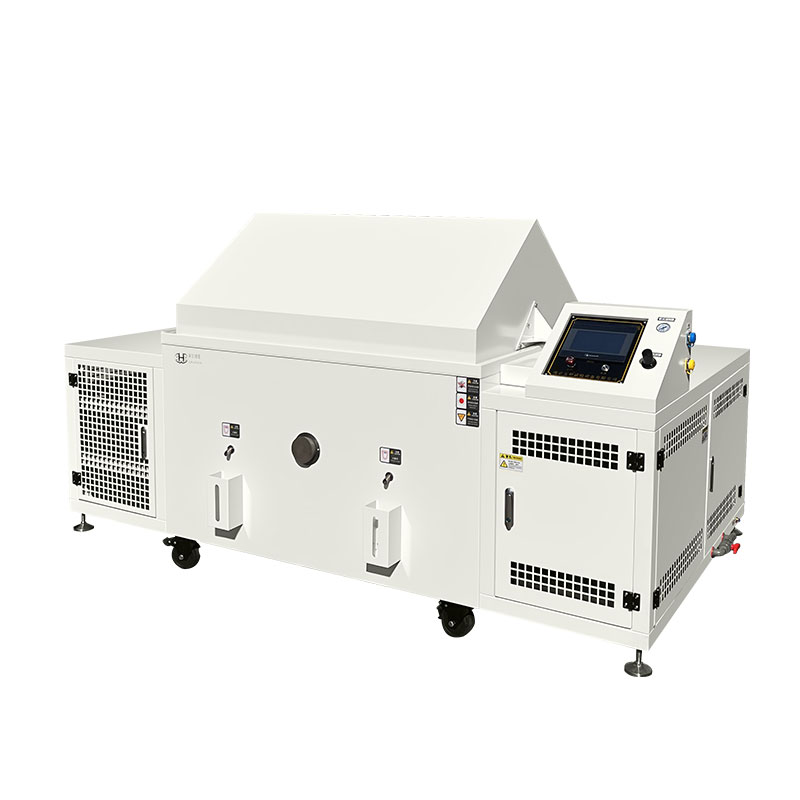
Specifications and Technical Parameters
|
Model |
WH-FJYWS-8m3T |
WH-FJYWS-15m3T |
WH-FJYWS-30m3T |
|||
|
Inner Dimensions D×W×H mm |
2000×2000×2000 |
3000×2500×2000 |
5000×3000×2000 |
|||
|
Technical Specifications |
Temperature Range |
+10℃ to +80℃ (Pure titanium inner chamber) |
||||
|
Temperature Uniformity |
≤ 2.0℃ |
|||||
|
Temperature Fluctuation |
±0.5℃ |
|||||
|
Humidity Range |
30%~98% |
|||||
|
Salt Spray Deposition Rate |
1~2ml/80cm2.h |
|||||
|
Spray Method |
Pneumatic type; continuous or intermittent spray adjustable |
|||||
|
Test Duration |
Adjustable 0–999 hours/minutes/seconds |
|||||
|
Temperature & Humidity Control System |
Temperature Control |
Touchscreen programmable controller |
||||
|
Temperature Sensor |
PT100Ω/MV platinum resistance with PTFE protective tube |
|||||
|
Heating System |
Titanium-tube air heaters for spray and air-duct heating |
|||||
|
Spray System |
Baffle-type spray device made of PC or pure titanium, Non-crystallizing nozzles, Salt solution delivered by peristaltic pump, Adjustable deposition rate |
|||||
|
Spray Time |
Adjustable 0–9999 (seconds/minutes/hours), cyclic setting available |
|||||
|
Chamber Humidity Control |
External boiler humidification |
|||||
|
Salt Solution Collection |
Standard funnel and graduated cylinder equipped |
|||||
|
Salt Solution Filtration |
Water-quality filter installed at suction tube (prevents nozzle blockage) |
|||||
|
Salt Solution Preheating |
Ensures salt solution temperature matches chamber temperature (avoids temperature interference) |
|||||
|
Materials |
Outer Chamber Material |
Coated metal sheets, composite coated panels, or stainless steel with coating |
||||
|
Inner Chamber Material |
Pure titanium plates |
|||||
|
Door Inner Panel Material |
Pure titanium plates |
|||||
|
Insulation Material |
Polyurethane foam |
|||||
|
Other Components |
Corrosion-resistant and high-temperature-resistant materials |
|||||
|
Standard Configuration |
One set of plastic or pure titanium load-bearing sample racks, Additional nozzles, Fog-collection funnel, Graduated cylinders and other complete accessories |
|||||
|
Safety Protection |
Leakage protection, short-circuit protection, over-temperature protection, water-shortage protection, test-completion protection, and over-current protection. |
|||||
|
Total Alternating Salt Spray Test Power |
25.0KW |
32.0KW |
45.0KW |
|||
|
Power Supply |
Compatible with international power configurations. |
|||||
|
Ambient Temperature & Humidity |
10℃~ 35℃ ≤85%R.H |
|||||
|
Sealing |
Silicone rubber sealing strips ensure airtight structure with no salt spray leakage. |
|||||
|
Technical specifications are subject to change without prior notice. |
||||||
Chamber Structure
Ø The chamber is constructed using modular insulated panels. The exterior is made of color steel plates, reinforced plastic panels, or stainless steel with powder coating. The inner walls are made of pure titanium plates, with polyurethane foam insulation inside;
Ø The chamber is equipped with single or double doors. The exterior and interior door panels use the same materials as the chamber body. Each door is equipped with a viewing window for clear observation of test specimens and spray conditions;
Ø A rear-mounted titanium air-circulation duct is used inside the chamber. The heating elements, refrigeration evaporator, fan impellers, and fan shafts inside the air duct are all made of pure titanium;
Ø Double silicone rubber seals are used between the double doors and the chamber body to ensure no salt spray leakage;
Ø A baffle-type spray system made of PC or pure titanium is used. The system includes a brine filtration unit and uses non-crystallizing nozzles. Salt solution is delivered by a siphon structure and a peristaltic pump. The sedimentation rate is adjustable, and salt spray distribution is uniform;
Ø The control circuit board and other components are placed in easily accessible positions. A lockable side access door is provided for convenient inspection and maintenance. Electrical and water circuits adopt a water–electricity separation design;
Ø The refrigeration system uses a Copeland scroll compressor, typically water-cooled. Other refrigeration components—such as solenoid valves, oil separators, receivers, check valves, and filters—are sourced from international brands including Castel, Danfoss, Emerson, and Ranco. Refrigerant is DuPont-brand imported refrigerant.
Control System
Ø 7-inch touchscreen with PLC programmable control; test programs can be edited freely;
Ø Continuous or cyclic spraying modes available. Cyclic (combined) salt spray tests include salt spray, damp heat, immersion, drying, and alternate cycle conditions;
Ø Electrical components use ABB, Omron, Carlo Gavazzi, or Noyak (UL-certified) components, fully compliant with U.S. electrical standards;
Ø Multiple protection functions including over-temperature protection, low-water-level alarm, and timing alarms ensure safe operation.
Test Methods
Ø Neutral Salt Spray (NSS) test,ASS – Acetic Acid Salt Spray (including sulfuric acid conditions per GJB150.28A),CASS – Copper-accelerated Acetic Acid Salt Spray,dwell, humidification, drying, natural air-drying, constant temperature and humidity, saltwater spray, freshwater spray, etc., in cyclic operation.。
Compliance with Standards
The equipment is designed and manufactured in accordance with the following standards:
Chinese Military Salt Spray Test Standard GJB 150.11A-2009; Chinese Military Acetic Acid Salt Spray Standard GJB 150.28A-2009; GB/T 1771-2007 Paints and Varnishes — Determination of Resistance to Neutral Salt Spray (NSS); GB 2423.17 Environmental Testing for Electric and Electronic Products — Salt Mist Test; GB 2423.18-2021 Environmental Testing — Alternating Salt Spray Test (Sodium Chloride Solution); DIN 50014-1985 Climatic Conditions and Their Technical Application — Standard Climates; DIN 50017-1982 Climatic Conditions and Their Technical Application — Condensation Water Climate Test Cabinet; DIN 50021-1988 Salt Spray Tests Using Various Sodium Chloride Solutions; PV 1210-2004 Corrosion Testing of Vehicle Bodies and Components; ASTM G85 Standard Practice for Modified Salt Spray (Fog) Testing; GB/T 10125-1997 Corrosion Tests in Artificial Atmospheres — Salt Spray Tests; GB/T 12967.3-2008 Test Methods for Anodic Oxidation Coatings on Aluminum and Aluminum Alloys — Part 3: Copper-Accelerated Acetic Acid Salt Spray (CASS) Test; QB/T 3826-1999 Neutral Salt Spray (NSS) Test Method for Metallic Coatings and Chemical Treatments on Light Industry Products; QB/T 3827-1999 Acetic Acid Salt Spray (ASS) Test Method for Metallic Coatings and Chemical Treatments on Light Industry Products; QB/T 3828-1999 Copper-Accelerated Acetic Acid Salt Spray (CASS) Test Method for Metallic Coatings and Chemical Treatments on Light Industry Products; GB/T 5170.8-2008 Verification Methods for Environmental Test Equipment — Salt Spray Test Chambers; GB 10587 Technical Requirements for Salt Spray Test Chambers.
Acceptance Conditions
ASTM B117 – Neutral Salt Spray Continuous Test;ISO 16750-4 – Salt Spray / Temperature & Humidity Cycling;GB 2423.18 – Salt Spray / Humidity / Dwell Alternating Test;VW 80000 – Spray / Dwell Alternating Test with Powered Operation;GMW 3172-9.4.7 – Salt Spray / Humidity Alternating Test;GMW 3172-9.4.8 – Drying / Spray Alternating Test.