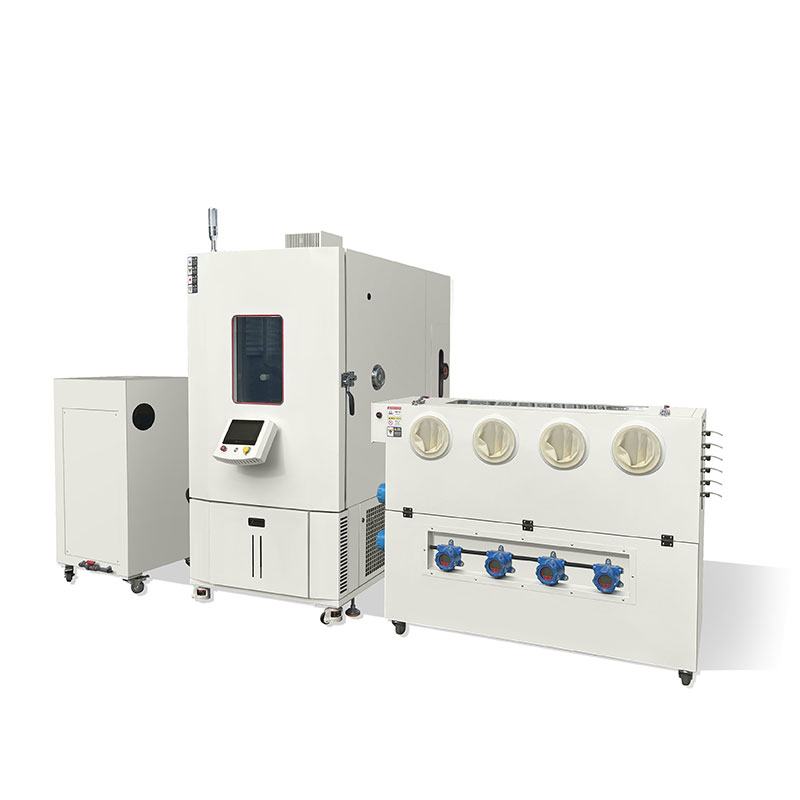
Specifications and Technical Parameters
|
Model |
WHQ-300B |
WHQ-600B |
WHQ-900B |
WHQ-960B |
WHQ-1350B |
|
|
Inner Dimensions D×W×H mm |
580*580*900 |
800*800*940 |
1000*1000*900 |
800×1500×800 |
1000×1500×900 |
|
|
External Dimensions D×W×H mm |
1600×950×2200 |
1700×1200×2300 |
1800×1400×2300 |
1600×2500×2100 |
1700×2500×2200 |
|
|
Performance |
Accessory Dimensions |
Sealed Gas Cylinder Cabinet:D450×W1600×H1200 |
Laboratory Exhaust Filtration Unit:D450×W550×H1200 |
|||
|
Temperature Parameters |
Range:10℃~60℃;Fluctuation:±0.5℃;Uniformity:2.0℃;Deviation±2.0℃; |
|||||
|
Humidity Parameters |
Range:(50%--98% )R·H Fluctuation:±2.0%R.H;Uniformity:5.0%R.H;Deviation±3.0%R.H; |
|||||
|
Corrosive Gas Concentration |
VL-5ppb to 100ppb; L-100ppb to 500ppb(0.5ppm);M-0.5ppm to 50ppm; |
|||||
|
Gas Concentration Control |
Indirect concentration control through mass flow meters. |
|||||
|
Gas Concentration Measurement |
Imported gas sampling and gas detection devices. |
|||||
|
Gas Source |
Gas cylinders (special certified standard gases). |
|||||
|
Sample Rack |
One set of adjustable-height horizontal racks made of pure titanium and PP (polypropylene) plastic; standard load capacity 30–50 kg, customizable for special requirements. |
|||||
|
Air Exchange Rate |
3–10 times (selectable based on test requirements). |
|||||
|
Total Power |
3.5kw |
6.5kw |
9.5kw |
9.5kw |
12.5kw |
|
|
Power Supply |
Compatible with international power configurations. |
|||||
|
Operating System |
Temperature & Humidity Controller |
7-inch Weilin touch screen; Setting accuracy: Temp ±0.1°C; Display accuracy: Temp ±0.1°C |
||||
|
Temperature & Humidity System |
Titanium-tube heater; titanium boiler for humidification; automatic control. |
|||||
|
Electrical & Refrigeration Components |
Electrical components from ABB, Omron, Carlo Gavazzi, or Noyak (UL-certified), compliant with U.S. electrical standards; Refrigeration components from Tecumseh, Castel, Danfoss, DuPont, etc. |
|||||
|
Air Exchange System |
Negative-pressure design; corrosion-resistant diaphragm pump forced air exchange; with spare parts. |
|||||
|
Gas Control |
Integrated mass flow meter system for indirect concentration control; imported devices for real-time concentration measurement. |
|||||
|
Safety Protection |
Corrosive Gas Safety Protection:Sealed gas cylinder cabinet; equipment and room filtration systems; triple-stage filtration; dual alarm system. |
|||||
|
Electrical Protection:Leakage, short circuit, over-temperature, water shortage, overcurrent, refrigeration overpressure/overcurrent protection; dual-door design for gas leak prevention. |
||||||
|
Technical specifications are subject to change without prior notice. |
||||||
Chamber Structure, Design, and Control
Ø The outer chamber is made of SUS 304 stainless steel with an additional powder-coated finish. The inner chamber is fabricated from SUS 316 stainless steel plates. All joints are smooth and even, ensuring a compact structure, bright appearance, and zero leakage.
Ø The sample chamber is fabricated from welded PP (polypropylene) sheets, ensuring a leak-proof seal. The chamber is pressure-tested to maintain integrity.
Ø The system operates based on a displacement mechanism. The temperature and humidity chamber generates the required environmental conditions, which are delivered to the sample chamber through 3–10 air exchanges. The controlled corrosive gases enter the sample chamber together with the temperature-humidity airflow, and after passing through the samples, are discharged into a filtration system.
Ø The inner door of the sample chamber is made from high-temperature-resistant transparent PC material and sealed with high-temperature and corrosion-resistant silicone rubber gaskets, combined with stainless-steel compression door locks to ensure airtight sealing.
The outer door is made of powder-coated 304 stainless steel, while the inner surface is made of 316 stainless steel. A viewing window made of PC material allows clear observation of the test status inside the chamber.
Ø Gas concentration detection ports are installed on the main door. The design allows sampling from the outer door, through the inner door, and directly into the sample chamber without opening the chamber, preventing air leakage or cross-contamination between compartments.
Ø Inside the chamber, an adjustable horizontal sample rack is installed, which can be set to any desired height. It is made of pure titanium and its load capacity is customized according to the client’s requirements.
Ø The equipment includes an integrated gas filtration unit. The laboratory room is also equipped with a secondary filtration system to ensure that exhaust gases are treated before being discharged. Any accidental leakage caused by improper operation or equipment malfunction will be captured and filtered immediately. The treated exhaust meets emission standards and prevents environmental pollution.
Ø Equipped with a sealed gas cylinder cabinet, where four cylinders of corrosive gases can be securely stored to ensure safety. A built-in gas concentration detection device is included to check the concentration of the cylinder gases.。
Ø Equipped with gas leakage alarms for the corrosive gases stored inside the sealed gas cylinder cabinet, as well as gas leakage alarms for the laboratory room. A total of two sets of alarms are provided for each type of gas.
Ø Four mass flow meters are designed, integrated into a single system for ease of annual calibration. A nitrogen or dry air cleaning device is installed for the flow meters to extend their service life.
Ø The internal gas concentration of the equipment can be monitored at any time. Each unit is equipped with one Japanese-imported sampling pump and four boxes of detection tubes for four types of corrosive gases. In addition, four boxes of high-concentration detection tubes are provided for monitoring gas cylinders, totaling eight boxes.
Ø The equipment is supplied with critical spare parts, including: one backup negative-pressure device, one dedicated spare pressure-reducing valve, one spare humidifying lift pump, one spare water tank level switch, one or two spare boiler heating tubes, and other spare components.
Ø The equipment’s unique design and the availability of key spare parts greatly reduce the likelihood of unexpected shutdowns during testing.
Ø Consumables included: four cylinders of corrosive gases, eight boxes of imported corrosive gas detector tubes, three sets of filtration materials, and three sets of safety masks and gloves.
Ø The equipment fully meets the requirements of the standard copper weight gain test and is supplied with 5 standard imported copper strips.
Ø The manufacturer can assist customers in conducting copper coupon weight-gain tests to ensure the equipment meets the required standard specifications.
Ø The equipment is equipped with a condensate water filtration system for the air-exchange device under high-temperature and high-humidity conditions, ensuring smooth and efficient air exchange.
Ø Electrical components are sourced from international brands such as ABB, Omron, and Carlo Gavazzi, or from Nader (UL-certified). All electrical components comply with U.S. electrical requirements.
Ø Refrigeration components are sourced from international brands such as Tecumseh, Castel, Danfoss, and DuPont.
Compliance with Standards
Ø GB/T 2423.19-2013, Test Kc: Sulfur dioxide test for contacts and connections, equivalent to IEC 60068-2-42:2003
Ø GB/T 2423.20-2014, Test Kd: Hydrogen sulfide test for contacts and connections, equivalent to IEC 60068-2-43:2003
Ø GB/T 2423.51-2020, Test Ke: Flowing mixed corrosive gas test, equivalent to IEC 60068-2-60:2015
The equipment is designed and manufactured to meet the test requirements for single or mixed corrosive gases, including sulfur dioxide (SO₂), hydrogen sulfide (H₂S), nitrogen dioxide (NO₂), and chlorine gas (Cl₂).It is also suitable for high-concentration single-gas corrosion tests using sulfur dioxide (SO₂) and hydrogen sulfide (H₂S).